
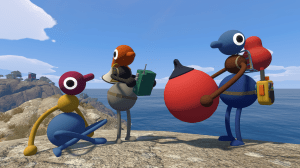
In an era dominated by competitive multiplayer games and single-player epics, a new title has emerged that redefines what cooperative gaming can be. Big Walk, developed by the Australian studio House House—the creative minds behind the viral sensation Untitled Goose Game—has arrived after three years of anticipation, and it delivers an experience that defies easy categorization. Described variously as a co-op walking simulator, a puzzle-adventure game, and even “friendslop,” this ambitious project transcends all these labels to create something genuinely unprecedented in the gaming landscape. After spending more than twenty hours exploring its Australian Outback-inspired world, one thing becomes abundantly clear: Big Walk represents a masterclass in cooperative game design.
The premise is deceptively simple. Players take control of vaguely humanoid characters—imagine colorful snowmen with elongated noses and noodle-like limbs—and embark on a journey across a vast, open island. Groups ranging from two to twelve players work together to hunt down mysterious objects (which many groups affectionately nickname based on their appearance) by solving an impressive array of inventive puzzles. This deliberately minimalist setup conceals remarkable depth that reveals itself gradually as players spend more time within its carefully crafted world.
A Masterfully Handcrafted World
Unlike many contemporary multiplayer games that rely on procedural generation, Big Walk features an entirely handcrafted island where every element feels intentional and purposeful. This design philosophy sets it apart from games like Peak, to which it has often been compared. The switchbacks winding down mountainsides aren’t just terrain features—they’re carefully positioned to offer tantalizing glimpses of distant landmarks. Radio stations scattered throughout the world each play unique songs that players can carry with them, adding a personal soundtrack to their adventures. House House has demonstrated that in an age of algorithmically generated content, there remains immense value in human-crafted experiences where every rock, tree, and structure serves a purpose.
The game begins in a starting area reminiscent of a children’s playground or gymnasium, filled with buttons to press, bouncy objects to manipulate, and climbable surfaces. This space serves as an organic tutorial, teaching players everything they need to know about the game’s mechanics without intrusive prompts or text boxes. Here, groups discover the extensive gesture system, learn how proximity chat functions, and understand the physics governing this whimsical world. Notably, falling great distances doesn’t result in damage, though it might mean losing a held item in a forest until sunrise illuminates the landscape once more.
Revolutionary Puzzle Design and Communication
The puzzle design in Big Walk represents some of the most innovative work seen in cooperative gaming. The first four puzzles serve as an extended tutorial, teaching fundamental concepts before unlocking virtually the entire island at once. From there, each group charts their own unique path through the world. Some puzzles require players to work shoulder-to-shoulder, timing actions precisely or manipulating buttons from specific vantage points. Others demand separation across great distances, transforming the simple act of reuniting into its own satisfying challenge. The game intelligently adjusts puzzle difficulty based on group size, with different versions of the island existing for parties of two, three, or four-plus players.
Communication lies at the heart of Big Walk’s genius. The game’s exclusive use of proximity chat creates natural friction that transforms into satisfying gameplay. Some puzzles deliberately inhibit communication—one memorable example traps a player behind soundproof glass, forcing them to relay information only they can see to teammates outside. Another standout challenge requires one player to wear a blinding helmet while navigating an obstacle course guided solely by their companions’ vocal directions. Hours later, this same helmet reappears with new rules, demanding players first identify correct objects before guiding the blindfolded teammate. This iterative approach to puzzle design, where concepts return with clever new wrinkles, keeps the experience feeling fresh throughout its duration.
Building Your Own Language Together
Perhaps Big Walk’s most remarkable achievement is how it encourages groups to develop their own vocabulary and communication systems. Without quest markers, on-screen prompts, or health bars, every discovery feels genuinely earned. The game presents fundamental video game elements—puzzles and rewards—but deliberately avoids definitive explanations. There’s no lore dump explaining who these strange characters are or why they’re solving puzzles on this seemingly uninhabited island. This ambiguity invites each group to craft their own narrative understanding.
This approach proves particularly powerful for intergenerational play. The gameplay loop—discover, experiment, prevail—feels universal in its appeal, bridging the gap between players of vastly different ages and skill levels. Where many games leave younger players behind with complex mechanics or leave experienced gamers bored with simplistic challenges, Big Walk finds a remarkable middle ground. The shared vocabulary that emerges organically—whether calling objectives “eggy things” or naming characters “walklings”—creates bonds unique to each group’s experience. The ritual of genuine discovery, cooperative experimentation, and shared elation forms the emotional core of the experience.
Polish, Accessibility, and Emotional Resonance
House House has delivered a remarkably polished product, with minimal technical issues marring the experience. The game’s defined ending means it isn’t designed for endless play, though it retains appeal with different groups of friends. Major rewards unlock periodically, including a train that traverses the island and a map room for plotting travels. Players might discover entirely missable shortcuts, reinforcing that triumphs belong to the group rather than any guidance system. Helpful items like walkie-talkies, flashlights, and megaphones appear throughout, often making puzzles easier without being strictly required.
The inventory system brilliantly reinforces the cooperative theme. Limited to what can be carried in hands, on belts, or in backpacks, players must rely on companions even for basic tasks like accessing stored items. This seemingly small design decision encapsulates Big Walk’s philosophy. Conceived during the COVID pandemic, House House explicitly aimed to create a game bringing people closer together through meaningful interactions. The final stretch of puzzles synthesizes everything players have learned, challenging groups to apply their shared knowledge in a genuinely mind-blowing culmination. The very last scene delivers a surprisingly bittersweet moment that elevates the experience beyond mere entertainment into something genuinely moving—a testament to how games can forge lasting memories through shared experiences.
Expert Opinion: Big Walk represents a significant evolution in cooperative game design, demonstrating that meaningful multiplayer experiences don’t require combat, competition, or complex mechanics. By stripping gameplay to its essential elements and trusting players to build understanding together, House House has created a blueprint that could influence cooperative game development for years to come. This title is poised to be a strong Game of the Year contender and may well define a new subgenre of collaborative exploration games.